
You walked outside expecting a sparkling backyard and found something closer to a pond. If you’re asking why is my pool green, the short answer is almost always the same: algae. The longer answer — and more importantly, how to fix it and stop it from happening again — depends on a few things that are especially common here in Central Florida.
The good news? A green pool is rarely the disaster it looks like. In most cases it’s completely recoverable, often within a few days. Here’s exactly what’s going on and what to do about it.
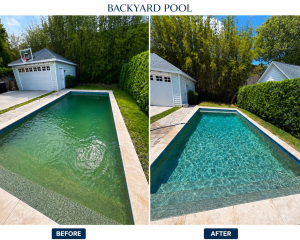
That green tint is a bloom of microscopic algae multiplying in your water. Algae spores are always present — they blow in on the wind, ride in on swimsuits, and wash in with rain. They’re harmless in small numbers because a properly sanitized pool kills them off before they can take hold.
The moment your water chemistry slips, though, those spores start reproducing fast. In warm weather, a clear pool can turn visibly green in 24 to 48 hours. What you’re seeing isn’t dirt you can scoop out — it’s living organisms that have to be killed and filtered out.
Understanding the cause matters, because clearing the algae without fixing what let it grow just means you’ll be green again next week.
Low or inconsistent chlorine. This is the number one culprit. Chlorine is what keeps algae in check, and if levels drop — even for a couple of days — algae seizes the opening. Missed maintenance, a broken chlorinator, or an empty feeder are all common triggers.
Florida sun burning off your sanitizer. Intense UV destroys unstabilized chlorine quickly. Without enough cyanuric acid (stabilizer) to protect it, your chlorine can be gone by afternoon, leaving the water defenseless during the hottest part of the day.
Heavy rain and storms. Central Florida’s afternoon downpours dilute your chemicals, throw off your pH, and wash in phosphates and organic debris that algae feed on. A single big storm can tip a borderline pool over the edge.
Poor circulation or filtration. If your pump isn’t running long enough, or your filter is dirty or undersized, the water sits stagnant — exactly the conditions algae love. Water that doesn’t move doesn’t get sanitized evenly.
Unbalanced water. High pH makes chlorine dramatically less effective, so even a “normal” chlorine reading can fail to protect the pool. Imbalanced alkalinity and stabilizer compound the problem.
Heat. Our long, hot season keeps pool water warm for most of the year, and warm water accelerates algae growth. This is why Florida pools go green more easily than pools up north.
It depends on how far it’s gone:
The single biggest factor is your equipment. If the pump and filter are running well, recovery is fast. If they’re struggling, that has to be sorted first — no amount of chemicals will clear a pool that can’t circulate.
If you want to tackle it yourself, here’s the general process:
It sounds straightforward, but severe blooms can be stubborn, expensive on chemicals, and frustrating when the water clears and then greens again. That’s usually a sign the underlying cause — equipment or chemistry — hasn’t been solved. If you’d rather skip the trial and error, our green pool recovery service handles the whole process and includes a plan to keep it from returning.
It’s tempting to think a full drain-and-refill is the fastest fix. In Florida, that can be an expensive mistake.
Our high water table means the ground around your pool is often saturated. Drain the pool and you remove the weight holding it down — and hydrostatic pressure from the groundwater can literally crack the shell or pop the entire pool out of the ground. Repairs can run into the thousands.
In the vast majority of cases, chemical recovery is faster, cheaper, and far safer than draining. Unless there’s a specific structural reason to drain (and there rarely is just for algae), keep the water in the pool and treat it.
Prevention is far easier than recovery:
That last point is the whole game. The homeowners who never deal with green water are the ones whose pools get looked at every single week. Consistent weekly pool maintenance catches a dropping chlorine level or a laboring pump before it becomes a green pool — which is a lot cheaper than fixing one.
Handle it yourself if the pool is only lightly green and your equipment is running well. But it’s worth calling a pro when:
A green pool looks alarming, but it’s one of the most fixable problems in pool care — as long as it’s handled correctly and the root cause gets solved. If yours has gone green and you want it cleared fast (without the guesswork or the risk of draining), Parks Pools has you covered across Orlando, Winter Park, Maitland, Altamonte Springs, and the surrounding area.
Contact us for a free assessment and we’ll get your water clear — and keep it that way.


